Case Study 5 – Answers
Use your BNF (paper or app) to answer the following questions
1. A 72-year-old man reports hearing loss during a prolonged inpatient stay due to an infection and has other co-morbidities. He had been treated with co-amoxiclav, gentamicin, furosemide, digoxin and aspirin.
What is the most likely cause of his hearing loss?
Answer: Gentamicin. Several medicines can cause hearing loss, whether temporary or permanent. This is rarely reported with the loop diuretics including furosemide but is a recognised adverse effect of gentamicin and other aminoglycosides. Gentamicin can damage the outer hair cells of the cochlea, causing irreversible sensorineural hearing loss. It is important when prescribing gentamicin that you follow the prescribing guidelines carefully, taking heed of the dose calculations, dosing intervals, and monitoring of gentamicin levels.
2. A 79-year-old man who is a resident in a care home, develops profuse diarrhoea with faecal incontinence. His recent medications include tamsulosin, atorvastatin, gentamicin, aspirin, co-amoxiclav and ramipril. His stool is positive for C difficile toxin showing that he has C difficile infection.
What medication is most likely to have increased his risk of C difficile infection?
Answer: Co-amoxiclav. Risk factors for C difficile infection (CDI) include a current or recent course of broad-spectrum antibiotics particularly the 4 C’s [co-amoxiclav, ciprofloxacin, clindamycin] and 3rd generation cephalosporins, age over 65 years, recent stay in a hospital or nursing home, use of proton pump inhibitors and immunosuppression. Most cases of CDI occur during or soon after taking antibiotics; narrower spectrum antibiotics are less of a risk of causing CDI.
3. Look up monographs for the following antibiotics and determine which need to be issued with a specific advisory label relating to taking with food. Why is it necessary for some antibiotics to be taken on an empty stomach?
Flucloxacillin, Clindamicin, Penicillin V oral solution, Cefalexin, Metronidazole
Answer:
Penicillin V, Flucloxacillin require Label 23 on dispensing:
Take this medicine when your stomach is empty. This means an hour before food or 2 hours after food
Metronidazole requires Label 21 on dispensing:
Take with or just after food, or a meal
Necessary to take on an empty stomach since the absorption of the antibiotics is reduced if food is in the stomach. If there is no warning label, then the antibiotic is unlikely to be affected by food in the stomach.
4. A 65-year-old man comes to the pharmacy complaining of itchiness and you note that he is jaundiced. He is currently on candesartan, amlodipine, aspirin, metformin and has recently had a 2-week course of flucloxacillin for a skin and soft tissue infection. What is the likely cause of his jaundice?
Answer:
Flucloxacillin: As per BNF safety information:
Cholestatic jaundice and hepatitis may occur very rarely, up to two months after treatment with flucloxacillin has been stopped. Administration for more than 2 weeks and increasing age are risk factors.
5. Look up monographs for the following antibiotics and determine which need to be issued with caution if a patient is on the combined oral contraceptive.
Amoxicillin, Rifampicin, Ciprofloxacin, Vancomycin, Co-trimoxazole
Answer:
Rifampicin: Due to its potent induction of CYP P450 enzymes, rifampicin interacts with numerous medications. It is important to advice the patient to take additional precautions while on rifampicin and for at least 2 weeks after finishing the course. Patients on rifampicin are likely to be on the medication for a long time.
“Combined hormonal contraceptives
Rifampicin is predicted to decrease the efficacy of Combined hormonal contraceptives. For FSRH guidance, see Contraceptives, interactions.
Severity:Severe Evidence:Study”
Despite ciprofloxacin being a CYP P450 enzyme inhibitor, it is not listed as interacting with combined oral contraceptives.
6. A-seven-year-old-child diagnosed with otitis media is prescribed Flucloxacillin oral solution at a dose of 250mg four times daily for 5 days.

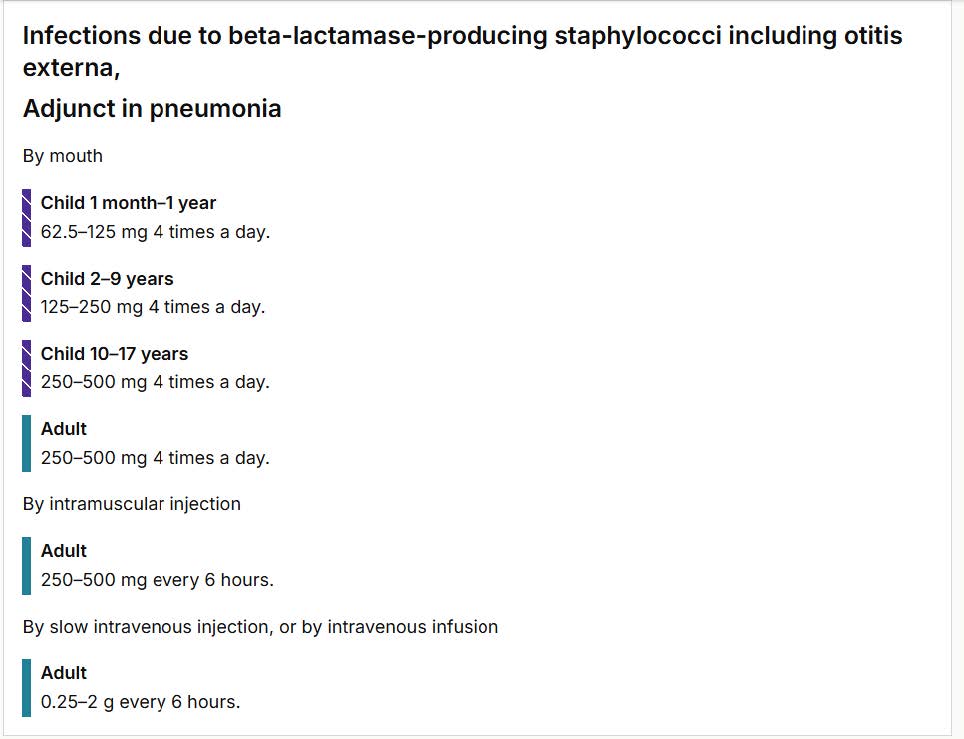
What is the total dose of flucloxacillin the child is being administered daily?
Answer: 250mg x 4 = 1000mg
What is the correct dose of flucloxacillin in mls the patient should be administered per dose?
Answer: 125mg/5ml = 10mls of solution
What is the total amount of oral solution required to last the patient 5 days?
Answer: 10mls x 4 = 40mls per day x 5 days = 200mls = 2 bottles
What instructions should be provided to the patient on dispensing?
Answer:
Using labels provided
To take TWO 5ml spoonfuls approximately every 6 hours
To complete the course even if feeling better
To take on an empty stomach – an hour before or 2 hours after food